
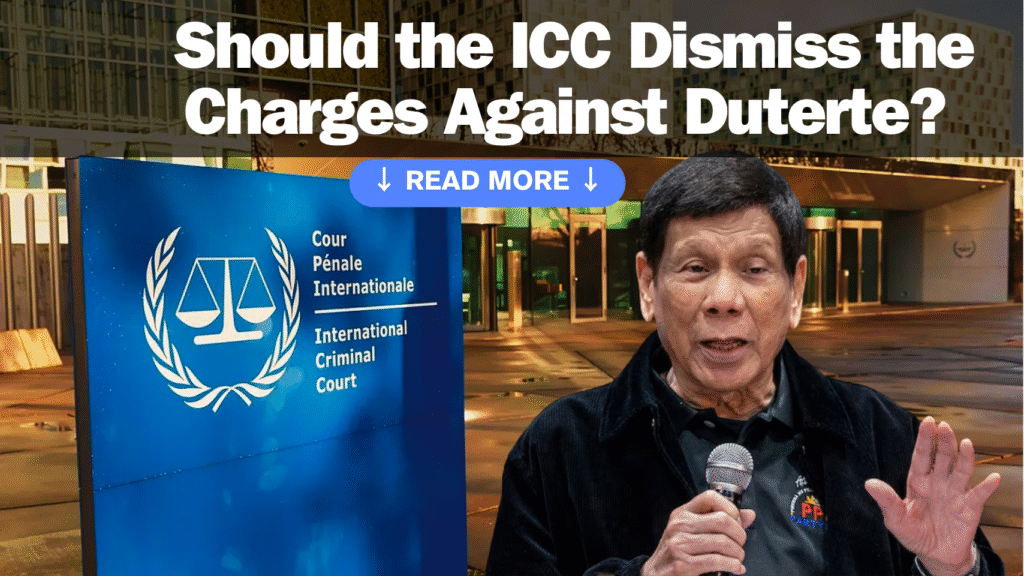
The International Criminal Court’s confirmation of charges hearing against former Philippine President Rodrigo Roa Duterte has drawn significant attention from legal experts, human rights advocates, and political observers worldwide. As proceedings unfold at The Hague, a critical question is emerging among international legal scholars: Is the prosecution’s case strong enough to survive legal scrutiny — or should the ICC dismiss the charges outright?
What Happened at the Confirmation Hearing?
The ICC’s confirmation of charges hearing, scheduled across four days — February 23–24 and February 26–27, 2026 — is a pivotal pre-trial stage where judges must determine whether there is sufficient evidence to proceed to full trial. Notably, the ICC Pre-Trial Chamber I issued a significant ruling allowing Duterte to be absent from the hearings.
In a decision released on a Friday afternoon (Manila time), the chamber stated that the signed waiver submitted by Duterte was sufficient to fulfill the legal requirements for a suspect’s right to waive participation in confirmation hearings.
“The Chamber, while acknowledging the objections of the Prosecution and the CLRV (Common Legal Representative of the Victims), considers that, in the present circumstances of the case, it is appropriate to proceed with the hearing on the confirmation of charges in the absence of Mr. Duterte,” the pre-trial judges stated, as reported by journalist Janvic Mateo.
ICC spokesperson Oriane Maillet clarified that Duterte’s absence was “based on the waiver of the suspect, not on reasons related to the health,” adding that an independent panel of medical experts had found Duterte fit to participate in pre-trial proceedings as of January 26, 2026.
Defense lawyer Nicholas Kaufman raised claims regarding the former president’s medical condition, but the judges noted that the defense’s submissions on this matter “are speculative, have no impact on the Court proceedings and are irrelevant.”
The Prosecution’s Core Argument — and Why Critics Say It Falls Short
During the first day of the hearing, the prosecution anchored much of its case on former President Duterte’s public statements — speeches, campaign rhetoric, and remarks made during his presidency from 2016 onward. The argument appears to be that these statements demonstrate that Duterte mandated or authorized the killings currently under investigation.
This prosecutorial strategy has drawn sharp criticism from legal observers and members of the defense.
Defense counsel Nicholas Kaufman emphasized during the proceedings that the ICC is a court of law, not a political forum, and that it is duty-bound to decide cases strictly on the basis of competent, admissible, and corroborated evidence — not on political discourse or selective quotations pulled from campaign rhetoric.
That principle sits at the heart of international criminal jurisprudence. Political speech — especially hyperbolic language deployed during campaigns — has historically been treated with significant caution in criminal proceedings. Courts worldwide have recognized that public statements made in political contexts do not automatically translate into criminal intent or criminal orders.
▶ WATCH: ICC HEARING VIDEO
ICC Pre-Trial Hearing | The Prosecutor v. Rodrigo Roa Duterte
The International Criminal Court (ICC) opens the confirmation of charges hearing against former Philippine President Rodrigo Duterte on February 23, 2026, at Courtroom I, The Hague, Netherlands. The hearing determines whether sufficient evidence exists to send the case to full trial.
📹 Source: YouTube | Case Reference: ICC-01/21-01/21 | Court: International Criminal Court (ICC) | Date: February 23, 2026
What Does International Criminal Law Actually Require?
Under the Rome Statute, which governs the ICC, command responsibility and individual criminal liability require far more than inflammatory rhetoric. Establishing criminal liability typically demands:
1. A clear chain of command — prosecutors must show that the accused had formal or effective authority over those who committed the alleged crimes.
2. Effective control — the accused must have had the actual ability to prevent or punish the conduct in question.
3. Specific orders — evidence must demonstrate that concrete, identifiable orders were issued that led to the alleged crimes.
4. A direct causal link — there must be a traceable connection between the accused’s actions or omissions and the crimes allegedly committed.
Critics of the prosecution’s approach argue that relying primarily on public speeches — without accompanying forensic evidence, documented chains of command, or specific operational orders — fails to meet this demanding threshold.
The Problem of Missing Forensic Evidence
Another dimension of concern surrounds the alleged absence of forensic and police documentation. Prosecution reliance on statements attributed to officials — including Justice Secretary Jesus Crispin Remulla, who reportedly suggested that domestic justice might be denied due to the absence of forensic and police reports — has drawn pointed responses.
Legal observers note that the absence of such fundamental evidentiary pillars is not a circumstance that strengthens a prosecution’s case before the ICC. In criminal proceedings, the lack of forensic evidence and police documentation is generally considered a serious evidentiary deficit, not a procedural justification for shifting the burden of proof.
For the court to uphold its credibility, it must evaluate what evidence exists, not construct liability around the vacuum left by missing evidence.
The Precedent Problem: A Warning for Future Leaders
Beyond the specifics of the Duterte case, critics have raised a broader concern: if political speeches alone can serve as the basis for international criminal charges, what does that mean for democratic governance more broadly?
Accepting such an evidentiary standard could, in principle, expose any sitting or former head of state to criminal liability simply for delivering tough policy rhetoric — even when no direct link to specific crimes has been established. The chilling effect on political speech and legitimate policy discourse could be significant, not just in the Philippines, but across ICC member states.
This is not a defense of violence or extrajudicial killings. Rather, it reflects a foundational principle of law: that criminal liability must be established through evidence, not through the political unpopularity of a leader’s words or policies.
What Comes Next?
The ICC Pre-Trial Chamber I will now evaluate whether the evidence presented by the prosecution is sufficient to confirm the charges and send the case to trial. This is a preliminary determination — not a verdict — but it is a critical legal gateway.
Should the chamber find that the prosecution has not met the required evidentiary threshold, it has the authority to decline to confirm the charges, a step that some legal analysts argue would be the legally sound outcome given the current state of the prosecution’s case.
The proceedings are being closely watched by legal communities, human rights organizations, the Philippine government, and victims’ groups. Whatever the outcome, the case will likely shape how international criminal law treats the intersection of political speech and criminal accountability for years to come.
Final Thought
The ICC was established to prosecute the gravest crimes under international law — genocide, crimes against humanity, and war crimes — with the highest standards of evidence and due process. Its credibility depends on upholding those standards rigorously, regardless of the political profile of the accused.
Courts convict on evidence. They confirm charges on evidence. Political rhetoric alone — however inflammatory — has never been, and should never become, a substitute for proof beyond reasonable doubt.
The world is watching how The Hague handles this case. What happens next will say as much about the ICC’s integrity as it does about the charges themselves.
Sources: ICC Pre-Trial Chamber I official rulings; ICC spokesperson Oriane Maillet statements; Rome Statute of the International Criminal Court.
This article presents a legal analysis of publicly available information and proceedings. It does not represent the personal views of any party to the ICC proceedings.
FAQs
What is the ICC confirmation of charges hearing for Duterte?
It is a pre-trial stage where judges determine whether sufficient evidence exists to send the case to full trial. Duterte’s hearings were scheduled February 23–24 and February 26–27, 2026, before the ICC Pre-Trial Chamber I at The Hague.
Can political speeches be used as evidence of criminal liability at the ICC?
Under the Rome Statute, establishing criminal liability requires a clear chain of command, effective control, specific orders, and a direct causal link to alleged crimes. Political speeches or campaign rhetoric alone do not typically satisfy this threshold.
Why was Duterte allowed to skip the ICC confirmation hearing?
The ICC Pre-Trial Chamber I granted his signed waiver request. ICC spokesperson Oriane Maillet confirmed the absence was based on the waiver, not health reasons, despite judges previously declaring Duterte fit to participate.
What charges does Duterte face at the ICC?
Duterte faces charges related to alleged extrajudicial killings carried out during his anti-drug campaign in the Philippines, beginning when he assumed the presidency in 2016.